THE DESIGN DECISIONS THAT QUIETLY INCREASE RESALE VALUE IN GREENWICH, CT
Where architecture, restraint, and market intelligence intersect.
Published March 2026
In Greenwich, the numbers can be dramatic. But what supports them is often quiet. It doesn’t shout through oversized islands or dramatic lighting. It holds through proportion, through material integrity, through decisions that add structural value — not visual noise.
At higher price tiers, buyers are not reacting to finishes alone. They are responding to coherence. And coherence is a design discipline.
Proportion Is the First Currency of Value
Before a buyer registers countertops or appliances, they feel scale.
- Ceiling height relative to room width.
- Window placement relative to wall mass.
- The rhythm of openings across a façade.
Correct proportion creates ease. Incorrect proportion creates subtle tension — even in newly renovated homes. You cannot correct awkward scale with expensive materials. But when proportion is right, even simplicity reads as elevated.
In established Greenwich neighborhoods, this distinction matters. Buyers may not articulate it — but it influences how confidently they move.
Flow Is Financial
In high-end residential design, circulation is everything. How you enter a home. Where coats disappear. How the kitchen connects to informal living. Whether a mudroom absorbs real life without broadcasting it.
A marble slab does not increase value if the layout resists movement. But a home that feels intuitive — that allows life to unfold without friction — reads as higher quality. And quality sustains price.
Light Is Structural, Not Decorative
Orientation in Greenwich is not aesthetic. It’s economic. Natural light enhances:
- Spatial perception
- Material texture
- Emotional warmth
A well-oriented home can outperform a more renovated neighbor simply because it feels expansive at 4:30 PM in February. That emotional ease converts to stronger engagement. And engagement drives competition
Material Integrity — and Architectural Depth
In higher price tiers, authenticity outperforms imitation.
- Natural stone over composite mimicry.
- Solid wood flooring over thin veneers.
- Materials that age gracefully rather than peel.
But integrity goes beyond surfaces.
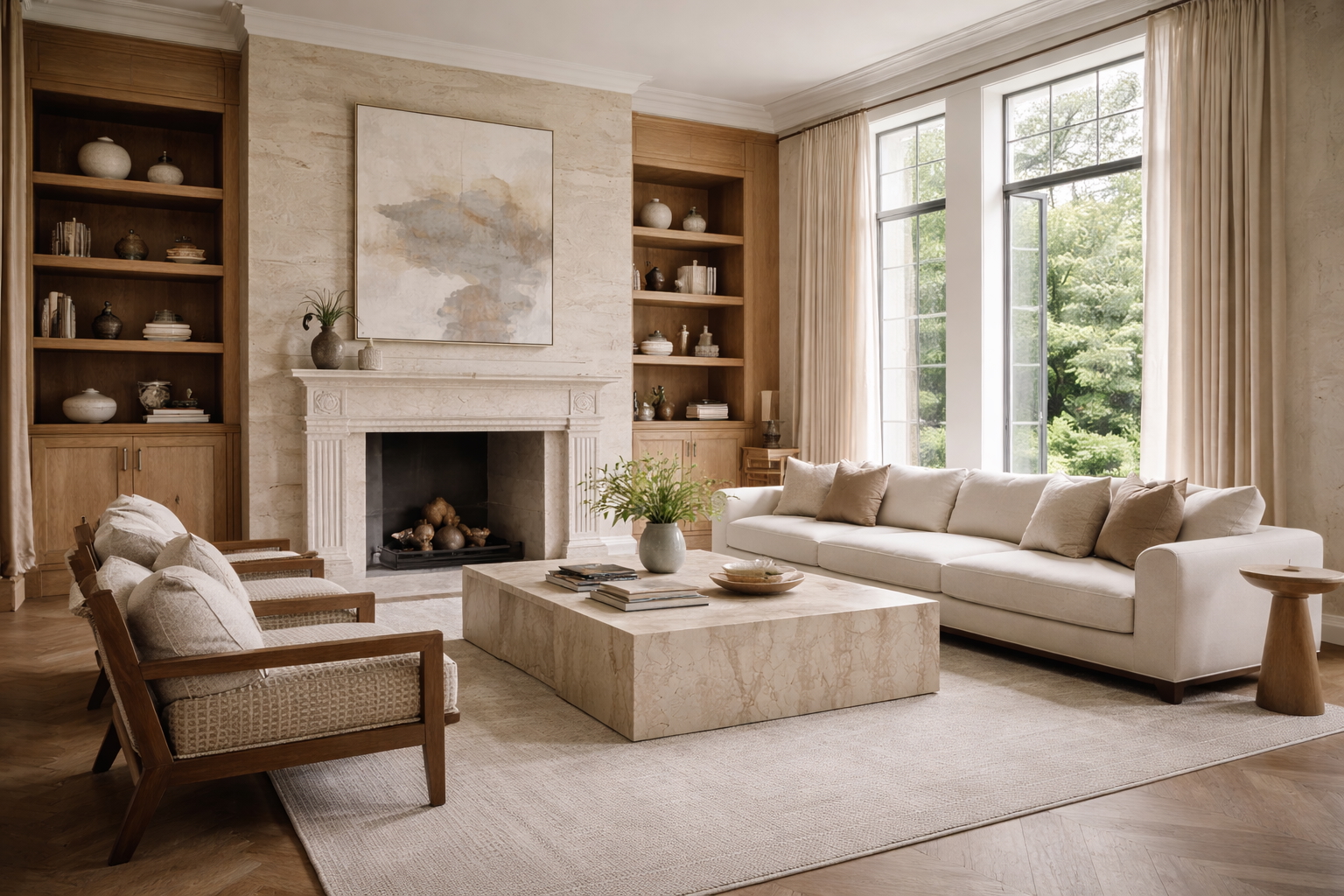
Architectural millwork — paneling, integrated shelving, proportionate built-ins — adds depth that plain walls cannot. A room with considered millwork feels anchored and walls feel intentional rather than vacant.
White walls can be beautiful. But white walls without articulation often read as temporary.
Integrated millwork, when scaled correctly to ceiling height and architectural era, signals permanence. And permanence signals value. Buyers may not consciously name this, but they respond to it.

Staging Is the Art of Removing Doubt
In Greenwich, staging is not about aspirational styling. It’s about eliminating hesitation. Vacant rooms exaggerate imbalance, they magnify proportion flaws. And they make scale harder to interpret.
Well-executed staging clarifies how a space lives. It reinforces architectural strengths without overwhelming them.
Over-staging narrows interpretation. Under-staging creates uncertainty. The goal is spatial confidence. And confidence is monetizable.
Where Renovation — and Recalibration — Multiply Return
Full-scale renovations absolutely create value in Greenwich — particularly when a property is elevated into a new architectural tier. Builders understand this well.
But not every home requires reinvention.
Many already sit in the correct category. What they lack is not structure — but resolution. And this is where disciplined cosmetic intervention becomes powerful.
I’ve seen properties with strong architecture, generous light, and coherent layouts underperform simply because they felt unresolved.
- Heavy paint tones absorbing natural light.
- Overscaled fixtures flattening ceiling height.
- Outdated hardware signaling neglect rather than character.
- Competing stone surfaces creating visual friction.
Nothing structurally flawed. But enough visual noise to introduce hesitation. And hesitation is expensive. Strategic recalibration can shift perception dramatically:
- Repainting in tones that restore architectural contrast
- Refinishing floors to correct undertone imbalance
- Replacing lighting to respect ceiling scale
- Simplifying surface combinations so materials read with clarity
- Updating select kitchen elements rather than replacing the entire room
These are not decorative changes. They are positioning adjustments.
In Greenwich, perception directly influences how decisively buyers move. Buyers do not price, “I could fix this.” They price, “I don’t have to.”
When uncertainty disappears, conviction rises. And conviction lifts price. Understanding where design intervention elevates category — versus where restraint protects margin — requires both architectural literacy and market awareness.
The Designer’s Advantage in Real Estate
My background in high-end residential design allows me to read homes differently. I evaluate:
- Structural proportion
- Circulation logic
- Light orientation
- Millwork integrity
- Material authenticity
- Where subtle intervention shifts perception
- Where intervention would dilute return
Design, at this level, is not about aesthetic preference. It’s about alignment. Alignment between architecture, buyer expectation, and market tier.
In Greenwich, alignment is what quietly protects resale.
Closing
If you’re preparing to sell, the question isn’t whether to update. It’s where design becomes leverage — and where it simply becomes decoration.
If you’re buying, the question isn’t whether a home is new. It’s whether its fundamentals will continue to hold.
That intersection — between architecture and market intelligence — is where long-term value is shaped. And it’s the lens through which I approach every property I represent.
———
Constanza Oquendo
Interior Designer & Real Estate Agent



© 2026 Coldwell Banker Real Estate LLC
203-244-2900