THE DESIGN DECISIONS THAT QUIETLY INCREASE RESALE VALUE IN GREENWICH, CT
Where architecture, restraint, and market intelligence intersect.
Published March 2026
In Greenwich, the numbers can be dramatic. But what supports them is often quiet. It doesn’t shout through oversized islands or dramatic lighting. It holds through proportion, through material integrity, through decisions that add structural value — not visual noise.
At higher price tiers, buyers are not reacting to finishes alone. They are responding to coherence. And coherence is a design discipline.
Proportion Is the First Currency of Value
Before a buyer registers countertops or appliances, they feel scale.
- Ceiling height relative to room width.
- Window placement relative to wall mass.
- The rhythm of openings across a façade.
Correct proportion creates ease. Incorrect proportion creates subtle tension — even in newly renovated homes. You cannot correct awkward scale with expensive materials. But when proportion is right, even simplicity reads as elevated.
In established Greenwich neighborhoods, this distinction matters. Buyers may not articulate it — but it influences how confidently they move.
Flow Is Financial
In high-end residential design, circulation is everything. How you enter a home. Where coats disappear. How the kitchen connects to informal living. Whether a mudroom absorbs real life without broadcasting it.
A marble slab does not increase value if the layout resists movement. But a home that feels intuitive — that allows life to unfold without friction — reads as higher quality. And quality sustains price.
Light Is Structural, Not Decorative
Orientation in Greenwich is not aesthetic. It’s economic. Natural light enhances:
- Spatial perception
- Material texture
- Emotional warmth
A well-oriented home can outperform a more renovated neighbor simply because it feels expansive at 4:30 PM in February. That emotional ease converts to stronger engagement. And engagement drives competition
Material Integrity — and Architectural Depth
In higher price tiers, authenticity outperforms imitation.
- Natural stone over composite mimicry.
- Solid wood flooring over thin veneers.
- Materials that age gracefully rather than peel.
But integrity goes beyond surfaces.
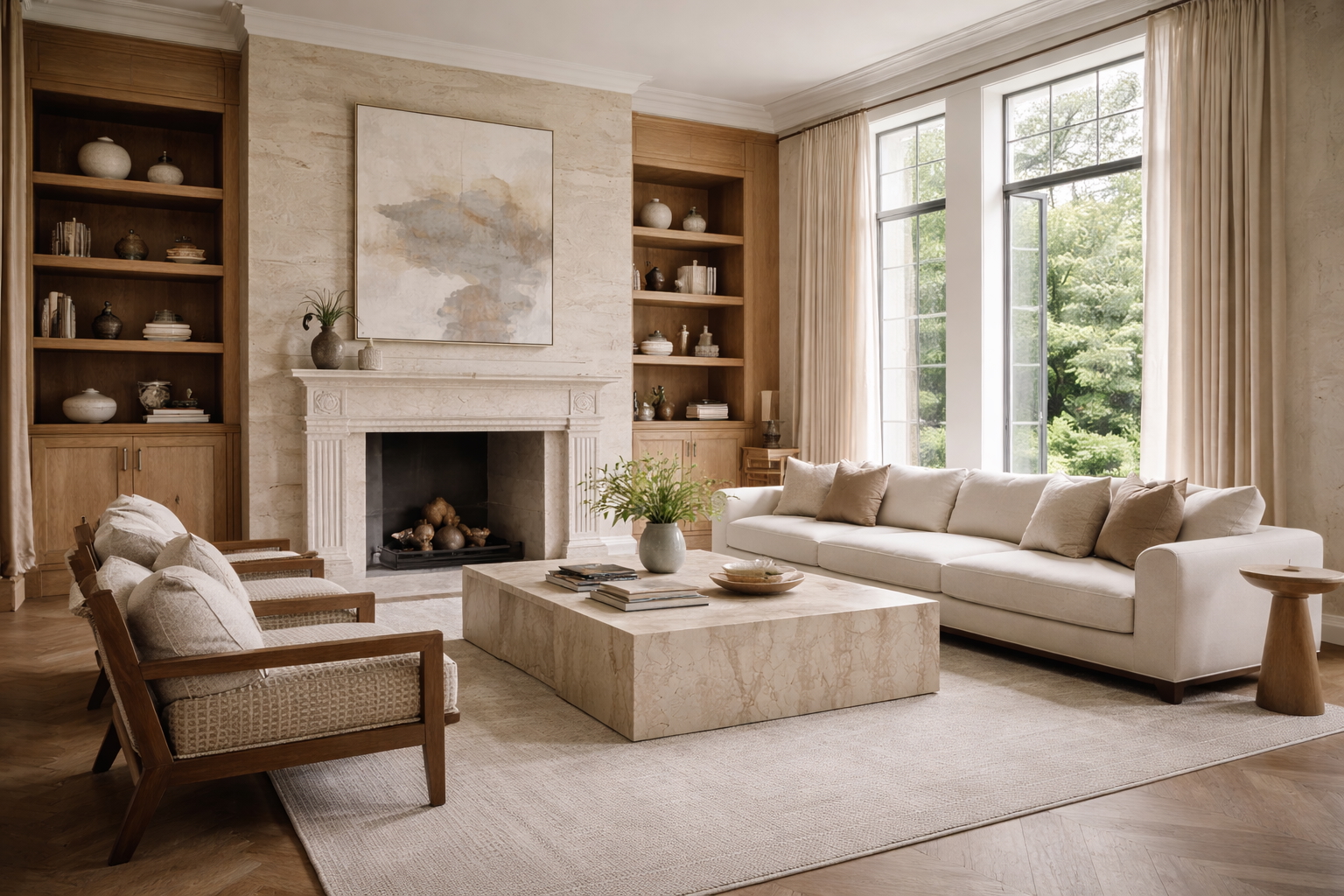
Architectural millwork — paneling, integrated shelving, proportionate built-ins — adds depth that plain walls cannot. A room with considered millwork feels anchored and walls feel intentional rather than vacant.
White walls can be beautiful. But white walls without articulation often read as temporary.
Integrated millwork, when scaled correctly to ceiling height and architectural era, signals permanence. And permanence signals value. Buyers may not consciously name this, but they respond to it.

Staging Is the Art of Removing Doubt
In Greenwich, staging is not about aspirational styling. It’s about eliminating hesitation. Vacant rooms exaggerate imbalance, they magnify proportion flaws. And they make scale harder to interpret.
Well-executed staging clarifies how a space lives. It reinforces architectural strengths without overwhelming them.
Over-staging narrows interpretation. Under-staging creates uncertainty. The goal is spatial confidence. And confidence is monetizable.
Where Renovation — and Recalibration — Multiply Return
Full-scale renovations absolutely create value in Greenwich — particularly when a property is elevated into a new architectural tier. Builders understand this well.
But not every home requires reinvention.
Many already sit in the correct category. What they lack is not structure — but resolution. And this is where disciplined cosmetic intervention becomes powerful.
I’ve seen properties with strong architecture, generous light, and coherent layouts underperform simply because they felt unresolved.
- Heavy paint tones absorbing natural light.
- Overscaled fixtures flattening ceiling height.
- Outdated hardware signaling neglect rather than character.
- Competing stone surfaces creating visual friction.
Nothing structurally flawed. But enough visual noise to introduce hesitation. And hesitation is expensive. Strategic recalibration can shift perception dramatically:
- Repainting in tones that restore architectural contrast
- Refinishing floors to correct undertone imbalance
- Replacing lighting to respect ceiling scale
- Simplifying surface combinations so materials read with clarity
- Updating select kitchen elements rather than replacing the entire room
These are not decorative changes. They are positioning adjustments.
In Greenwich, perception directly influences how decisively buyers move. Buyers do not price, “I could fix this.” They price, “I don’t have to.”
When uncertainty disappears, conviction rises. And conviction lifts price. Understanding where design intervention elevates category — versus where restraint protects margin — requires both architectural literacy and market awareness.
The Designer’s Advantage in Real Estate
My background in high-end residential design allows me to read homes differently. I evaluate:
- Structural proportion
- Circulation logic
- Light orientation
- Millwork integrity
- Material authenticity
- Where subtle intervention shifts perception
- Where intervention would dilute return
Design, at this level, is not about aesthetic preference. It’s about alignment. Alignment between architecture, buyer expectation, and market tier.
In Greenwich, alignment is what quietly protects resale.
Closing
If you’re preparing to sell, the question isn’t whether to update. It’s where design becomes leverage — and where it simply becomes decoration.
If you’re buying, the question isn’t whether a home is new. It’s whether its fundamentals will continue to hold.
That intersection — between architecture and market intelligence — is where long-term value is shaped. And it’s the lens through which I approach every property I represent.
———
Constanza Oquendo
Interior Designer & Real Estate Agent
THE ILLUSION OF “OVERPAYING” IN GREENWICH, CT
What buyers get wrong about price—and what smart buyers evaluate instead.

Published March 2026
There’s a moment in nearly every Greenwich purchase when someone says it. “But… are we overpaying?” It’s usually said quietly. Like a confession. Like the buyer has just spotted a trap door beneath the dream kitchen.
And I get it. If you’re coming from New York, you’ve been trained to treat pricing like a logic puzzle: compare the comps, calculate the spread, negotiate the win. You’re conditioned to believe the market always reveals a “correct” number—like a right answer you can arrive at if you’re smart enough.
Greenwich doesn’t work like that. Not because it’s irrational. Because it’s granular.
In Greenwich, “overpaying” is often an illusion created by comparing the wrong things, misunderstanding the micro-market you’re actually buying into, or evaluating a home as a product instead of a long-term asset.
Let’s break down what’s really happening.
The truth: Greenwich isn’t one market. It’s a collection of micro-markets.
Greenwich pricing isn’t a single scoreboard. It’s dozens of smaller games happening at once—sometimes on the same street. A home is not just “in Greenwich.” It’s in:
- a specific school zone
- a specific commute reality
- a specific land profile
- a specific neighborhood with its own buyer psychology
- a specific inventory shortage (or surplus) at that exact price point
Two houses can both be 4-bed, 3-bath, similar square footage—and yet behave like entirely different assets. That’s why the “comp” obsession can backfire. The market punishes simplistic comparisons.
Why the “overpaying” fear shows up
Most buyers are reacting to one of these four triggers:
1) You’re comparing a home to the wrong reference set
People often compare:
- a renovated home to an unrenovated comp
- a prime street to a secondary street
- a home with strong land to one with compromised land
- a turnkey home to a “project” without correctly pricing risk
If you compare the wrong inputs, your conclusion will be wrong—no matter how “data-driven” you are.
2) You’re reading price per square foot like it’s a rule
Price per square foot is a blunt instrument. It’s helpful as a clue, not a verdict. In Greenwich, land value, layout function, light/orientation, and neighborhood demand can matter more than square footage math.
Some buyers “overpay” for square footage and underpay for fundamentals—then wonder why resale is harder later.
3) The house feels emotional—and that scares people
If you love it, you assume you’re being irrational. But loving a house isn’t automatically bad. The real question is whether you’re loving something that also has structural demand: location strength, functionality, school anchor, land value, long-term buyer appeal.
Emotion is only dangerous when it blinds you to fundamentals.
4) You’re confusing “winning” with “buying well”
In competitive pockets, you don’t always “win” by paying the lowest number. You win by buying a home that performs:
- Holds value
- Resells smoothly
- Fits your life without costly regret
- Doesn’t force you into unnecessary compromises
Sometimes the smartest purchase is simply: the best home available in the micro-market you actually want.
What smart Greenwich buyers evaluate instead
Here’s the framework I use with clients to replace the “overpaying” anxiety with clarity.
- A) Fundamentals that protect downside
These don’t guarantee appreciation—but they reduce regret:
- street quality and noise exposure
- school zone strength and buyer consistency
- land usability (not just acreage)
- layout that works without heroic renovation
- light/orientation (because buyers feel it instantly)
- “future-proof” function: mudroom flow, bedroom placement, flexibility
Good design can be adjusted. Good fundamentals are harder to change.
- B) Renovation risk: real cost, real disruption
If you’re buying a home that needs work, the purchase price is only part of the cost. You’re also buying:
- timeline risk
- permitting variables
- contractor availability
- budget creep
- emotional fatigue
A lower purchase price can still be a more expensive decision.
- C) Liquidity: who else will want this later?
Even if you plan to stay, you should understand your buyer pool. Ask:
- Is this home easy to understand?
- Does it solve common family needs?
- Is the layout intuitive?
- Does the property have broad appeal—or niche appeal?
A “good deal” on something niche can be a bad asset when you go to sell.
- D) Timing and inventory realities
If inventory is thin in a specific pocket, pricing behaves differently.
A home doesn’t just have a value. It has a value in the context of what else exists that month. That’s why “It sold for less last year” isn’t always meaningful without context. Markets are seasonal, inventory-driven, and buyer-psychology-driven.
So… how do you know if you’re actually overpaying?
Here are the real red flags:
- You’re paying a premium for cosmetic finishes without strong fundamentals
- The layout has functional issues that will limit future demand
- The land has hidden constraints (usability, noise, wetlands, exposure)
- The neighborhood micro-market doesn’t support the price level historically
- The “dream house” requires a renovation you’re underestimating
- You’re ignoring better-aligned options because you’re anchored to aesthetics
And here are the green flags that often look like “overpaying” but aren’t:
- It’s a rare offering in a high-demand pocket
- It’s turnkey with strong fundamentals (less risk, more liquidity)
- The layout solves real life elegantly
- It’s priced as a finished decision, not a future project
The bottom line: Overpaying isn’t a number. It’s a mismatch.
In Greenwich, the real risk isn’t paying above ask. The real risk is paying for the wrong thing.
The buyers who feel best after closing aren’t the ones who negotiated the most dramatic “win.” They’re the ones who bought a property that makes sense—financially, practically, and long-term.
If you’re looking at homes in Greenwich and you want a clear-eyed read on whether something is truly overpriced—or simply priced correctly for its micro-market—that’s exactly where I’m most useful. Because the difference isn’t obvious… until it is.
Deeper learning for buyers
If you want to go deeper on this topic, here’s what I recommend:
1) Learn to read the market like a local
- Track sold listings (not just active) in the exact neighborhoods you like
- Keep a simple “watch list” spreadsheet: asking price, sold price, DOM, notes
2) Understand renovation economics (without becoming a contractor)
- Read: Renovation cost guides (regional cost vs national averages)
- Ask any contractor you trust for ballpark ranges early—before you fall in love
3) Study micro-market indicators (practical version)
- Days on market trends in your price point
- Absorption rate (how quickly inventory is moving)
- Seasonality patterns (spring vs fall behavior)
4) Train your eye (this is the design advantage)
- Learn to distinguish: cosmetic vs structural value
- A useful lens: “Can this home live well without major intervention?”
5) Good general reading (fast, useful)
- A personal finance lens on housing decisions (opportunity cost, liquidity, total cost of ownership)
- Behavioral finance basics (why fear spikes during big purchases)
A Personal Note
I’ll tell you something most agents won’t. When we bought our home in Greenwich, I lost sleep. Not one night, several because I was convinced we had overpaid. I replayed the comps. I questioned the negotiation. I second-guessed the timing.
Emotion is louder than logic in the first few weeks.
What I learned later — and what I now help clients see more clearly — is that early anxiety is often a byproduct of writing the largest check of your life, not evidence of a bad decision.
A year later, the market validated the positioning. The value increased significantly. But the real lesson wasn’t the appreciation. It was this: The fear of overpaying can be loud even when the decision is sound. That distinction matters.
If you’re worried about overpaying, that tells me you care about getting it right.
Good.
Because in Greenwich, the smartest buyers aren’t the ones who pay the least. They’re the ones who understand what they’re paying for.
———
Constanza Oquendo
Interior Designer & Real Estate Agent
WHAT NO ONE TELLS YOU ABOUT MOVING FROM NYC TO GREENWICH, CT
A thoughtful look at lifestyle, community, commute, and real estate fundamentals for families considering the move.

Published March 2026
There’s a version of this story everyone tells. You trade vertical living for horizontal space. You swap noise for quiet.
But that’s not the real shift. The real shift is psychological, financial, logistical — and slightly existential.
Let’s talk about the part no one puts in the relocation brochure.
You Don’t Just Move — You Recalibrate
In New York, you optimize. Square footage is negotiated, storage is engineered, noise is tolerated. You adapt.
In Greenwich, the first surprise is space. Actual space. Closets that don’t require strategy. A backyard that changes how your children — and you — move through the day.
But here’s what no one says: In NYC, location is everything. In Greenwich, location within location is everything. Micro-markets matter. Streets matter. Even which side of the street can matter.
You begin thinking like an investor without realizing it.
It’s Not “Cheaper.” It’s a Different Asset Class.
Yes, you get more for your money. But Greenwich is not a discount suburb. It’s a capital repositioning. You’re buying:
- School zoning
- Land value
- Long-term demand stability
- Predictable buyer behavior
Price per square foot becomes less relevant than fundamentals. A quiet street can outperform a busier one three blocks away for years. Strong fundamentals protect downside and amplify upside when cycles move.
And yes — I was genuinely surprised by how well our investment performed within the first year. Not because markets magically rise, but because strong positioning compounds.
Time Multiplies
This was the biggest surprise.
In NYC, getting anywhere averages 30–45 minutes door to door — even when it looks close on a map. In Greenwich, five to ten minutes is standard: school, sports, grocery, beach, friends’ houses.
Your day stretches. You don’t feel compressed between subway stops and traffic lights. The result isn’t boredom — it’s capacity. More hikes. More spontaneous beach walks when you need space. More grilling while kids jump on the trampoline. More “we’re at the beach, come join” texts.
No one told me family time would expand exponentially without trying. And here’s the funny part: you stop overthinking dinner on weekends. Somehow, my husband now believes any edible protein can be “handled on the grill.”
Weekend cooking anxiety evaporates when you can open a door and light something on fire outside. This is not discussed enough.
Your Children Don’t Just Adjust — They Expand
No one prepared me for this.
Your kids don’t just “have more space.” They flourish. Sports become real — not squeezed between logistics. You see them thrive physically, socially, emotionally. I did not expect how much it would move me to watch:
- My son riding his bike down the block with neighborhood friends
- Kids knocking on our door unannounced
- Afternoons flowing between backyards
- Saturday soccer mornings that feel like collective euphoria
Being a soccer parent here isn’t stress. It’s adrenaline. It’s cheering with other parents who slowly become your people.
There is more community here than I expected — less individualism, more overlap. And that changes everything.

Your Social Life Doesn’t Shrink — It Reorganizes
I assumed suburban life meant social slowdown. It didn’t. There is always something happening. Beach mornings turn into dinners, sports turn into friendships, weekends develop rhythm.
And the part that surprised me most? I thought I was a forever New Yorker. I held onto our NYC rental for over a year after we moved because I was convinced I’d panic and want to go back.
I never did. Now, the days I return to the city require coordination. That humbled me more than I expected.
The Era Shift
Let me say this clearly:
New York was perfect for my married-and-student era. It gave me culture, energy, access, momentum, identity. Greenwich is perfect for my family era. It gives me space, community, stability, time, expansion. One wasn’t better. They were right for different chapters.
You don’t outgrow New York. You evolve. And sometimes, that evolution needs more sky.
You Don’t Actually Leave New York
Here’s the part no one clarifies properly: Moving from NYC to Greenwich, CT isn’t disappearing from the city. It’s one train away.
Our date nights? Still in Manhattan.
Friends’ birthdays? We show up.
Events? We don’t miss them.
Museums with the kids? Still part of the rhythm.
The commute from Greenwich to NYC is predictable, manageable, and often easier than crossing boroughs on a weekday.
You’re not abandoning the city — you’re adding space to it. It becomes the place you go to, not the place that compresses you daily. That distinction changes everything.
For many families, living in Greenwich, CT isn’t about choosing suburbs over New York. It’s about having access to both — without sacrificing either.
So Should You Move?
That’s the wrong question. The better question is: what are you optimizing for now? If the answer includes:
- Strong fundamentals
- Schools that anchor value
- A market that rewards positioning
- Time that stretches instead of compresses
- Children who thrive in open air
- Community that overlaps naturally
Then the move isn’t an escape. It’s an expansion.
If you’re secretly Zillow-scrolling Greenwich at midnight, you’re not alone. And if you’ve moved past “How many bedrooms?” and into “Is this the right chapter?” — that’s where it gets interesting.
I’m Constanza Oquendo — an interior designer and real estate agent serving the Greenwich, CT market who made the move herself.
My design background allows me to see beyond finishes and into structure, flow, and long-term potential — offering clients full-service guidance from acquisition through refinement.
Because this move isn’t about leaving New York. It’s about expanding intelligently. And in this market, small details shape big outcomes.
———
Constanza Oquendo
Interior Designer & Real Estate Agent



© 2026 Coldwell Banker Real Estate LLC
203-244-2900